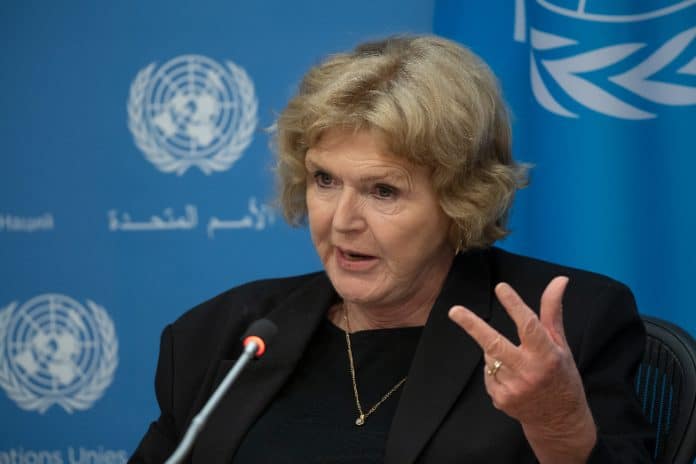
A United Nations expert says many governments are making life harder for people who protest peacefully about climate change. Mary Lawlor, the UN special rapporteur for human rights defenders since 2020, told a newspaper that she has seen hundreds of cases where states try to smear and silence climate defenders. According to her, officials are denigrating, delegitimizing, and even criminalizing people who join non-violent protests, do civil disobedience, or take climate cases to court.
Lawlor says the problem is not only in countries usually blamed for poor human rights. It also happens in places that claim to defend rights, including the UK, Germany, France, and the US. She argues these governments talk loudly about limiting warming to 1.5°C, but act differently when people protest. In her words, it is “business as usual.”
Her penultimate report, called “Tipping points: Human rights defenders, climate change and a just transition,” is due to be presented to the UN General Assembly on 16 October. The report lists common tactics used against activists. These include police violence and surveillance, civil lawsuits designed to wear people down—known as SLAPPs (strategic lawsuits against public participation)—and a long menu of criminal charges. Activists have faced accusations such as sedition, criminal defamation, terrorism, conspiracy, trespass, public disorder, and disobedience. Many of these charges are later dropped or overturned, but the process itself is the punishment.
Recent examples show how far this can go. In December 2023, Just Stop Oil member Stephen Gingell became the first person jailed under the UK’s new public order law after joining a peaceful 30-minute slow-march on a London road. Lawlor calls these rules “draconian” and says they are designed to stop protest on issues that embarrass the government.
In the US state of Minnesota, about 1,000 criminal cases were brought against people protesting the Line 3 oil pipeline. Charges ranged from trespass on “critical infrastructure” to other serious counts. Most cases were later dismissed or overturned, but concerns about Indigenous lands, environmental harm, and climate impacts were ignored. The pipeline began operations in 2021 anyway. Lawlor’s report says this mirrors the 2016 Indigenous-led movement against the Dakota Access pipeline. In both situations, there was close collaboration between private companies and the police—a kind of blueprint for repressing climate activism.
Another trend worries Lawlor: mixing up non-violent climate action with “terrorism.” In 2022, a French minister accused the environmental group Les Soulèvements de la Terre of “ecoterrorism.” The government tried to shut the group down. Later, France’s highest administrative court overturned that effort. Even so, the message to activists was clear.
Lawlor insists that climate activists are human rights defenders. By trying to stop fossil-fuel projects and push leaders to act, they are protecting basic rights: food, clean water, health, life, and a healthy environment. Yes, some groups are disruptive, she admits, but civil disobedience has long been used when “normal” methods fail—she points to historic figures like Martin Luther King and Gandhi. Her warning is stark: treating peaceful defenders like criminals is a road to destruction—for people, for the climate, and for democracy.