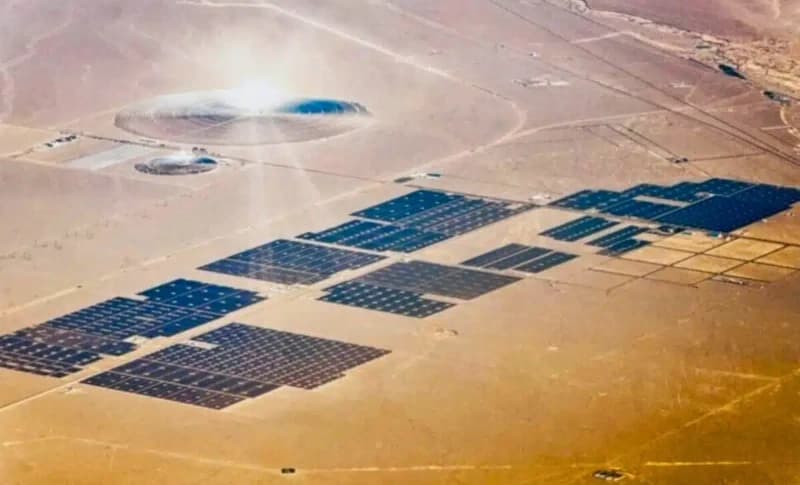
Something amazing is happening in China's Talatan Desert! Researchers have discovered that huge solar panels are changing the environment beneath them in surprising ways.
The Talatan Desert in Qinghai Province is one of China's harshest environments. Located nearly 2,910 meters above sea level, this remote plateau experiences extreme temperature changes between hot days and freezing nights. The region receives only about 246 millimeters of rainfall each year, making the soil dry and fragile. Strong winds frequently sweep across the land, carrying away loose soil and preventing plants from growing. For years, scientists described this area as one of western China's most difficult desert environments.
Everything began changing after the construction of the Qinghai Gonghe Photovoltaic Industrial Park, one of the world's largest desert solar energy projects. Thousands of solar panels were installed across roughly 64 square kilometers of barren land. The project was designed to generate renewable energy using the region's intense sunlight.
Soon after installation, researchers noticed something unexpected. The ground beneath the solar arrays behaved differently from the surrounding desert. Soil temperatures were cooler, and moisture seemed to last longer after rare rainfall. Curious about these observations, scientist W. Wu and his team began a detailed investigation.
The researchers divided the solar park into three distinct zones: land directly beneath the panels, spaces between panel rows, and untouched desert outside the installation. They measured 57 ecological indicators including soil moisture, vegetation growth, microorganism activity, and temperature patterns.
The results were remarkable! The solar panels created microclimate zones within the desert. Shadows from the panels reduced direct heating of the soil and slowed evaporation. With less heat reaching the ground, moisture remained longer. Land beneath the panels scored 0.4393 on ecological performance, compared with 0.2858 between panels and 0.2802 in the surrounding desert.
Even more exciting was the return of vegetation. Hardy grasses and desert plants began establishing themselves beneath the cooler panels. While vegetation remained sparse, plant roots started stabilizing loose soil and reducing wind erosion. The solar arrays also acted as wind barriers, helping young plants survive.
These changes are particularly important for China, where desertification affects roughly one quarter of total land area. Large solar installations now occupy environmentally fragile landscapes. Some projects are exploring agrivoltaics, combining solar infrastructure with vegetation systems to stabilize soils while producing electricity.
The Qinghai solar park demonstrates that renewable energy facilities can influence desert landscapes in interconnected ways. By altering sunlight exposure, wind movement, and soil moisture, solar panels can gradually reshape local environmental conditions. Researchers say continued monitoring will reveal how these ecological changes develop over time. For now, the solar arrays keep generating clean electricity while the ground beneath them slowly transforms into a more stable desert ecosystem.