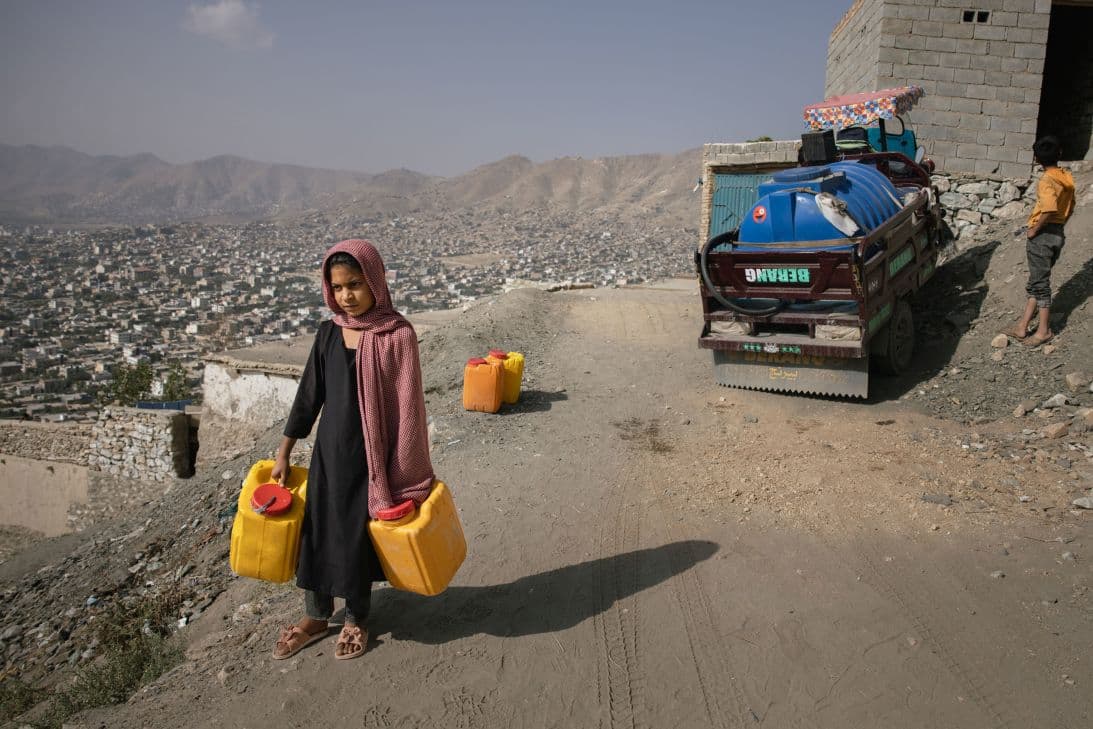
Regions across the world face severe water problems: Kabul may become the first modern city to run out of water. Mexico City is sinking at around 20 inches per year as the massive aquifer beneath it is over-pumped. In the US Southwest, states battle over how to share the shrinking water of the drought-affected Colorado River.
The global situation is so serious that terms like "water crisis" or "water stressed" don't capture its magnitude, according to the report published Tuesday by the United Nations University.
"If you keep calling this situation a crisis, you're implying that it's temporary. It's a shock. We can mitigate it," said Kaveh Madani, director of the UN University's Institute for Water, Environment and Health, and the report's author. With bankruptcy, while it's still essential to fix problems where possible, "you also need to adapt to a new reality, to new conditions that are more restrictive than before," he told CNN.
The concept of water bankruptcy works like this: Nature provides income in the form of rain and snow, but the world is spending more than it receives, extracting from rivers, lakes, wetlands and underground aquifers much faster than they refill, putting us in debt. Climate change-driven heat and drought are making the problem worse, reducing available water.
The result is shrinking rivers and lakes, dried-up wetlands, declining aquifers, crumbling land and sinkholes, the spread of desertification, a lack of snow and melting glaciers.
The statistics in the report are shocking: more than 50% of the planet's large lakes have lost water since 1990, 70% of major aquifers are in long-term decline, an area of wetlands almost the size of the European Union has disappeared over the past 50 years, and glaciers have shrunk 30% since 1970. Even in places where water systems are less pressured, pollution is reducing the amount available for drinking.
"Many regions are living beyond their hydrological means" and it's impossible now to return to conditions that used to exist, Madani said. It brings human consequences: nearly 4 billion people face water scarcity for at least one month every year.
Yet, instead of recognizing the problem and adjusting consumption, water is taken for granted and "credit lines keep increasing," Madani said. He referred to cities like Los Angeles, Las Vegas and Tehran, where expansion and development have been encouraged, despite limited water supplies. "Everything looks right until it's not," and then it's too late, Madani said.
Some regions are affected more severely, the report noted. The Middle East and North Africa deal with high water stress and extreme climate vulnerability. Parts of South Asia are experiencing chronic declines in water due to groundwater-dependent farming and growing urban populations.
The US Southwest is another hotspot, according to the report. Madani pointed to the Colorado River, where water sharing agreements are based on an environmental situation that no longer exists. Drought has shrunk the river, but it's not a temporary crisis, he said, "it's a permanent new condition, and we have less water than before."
The findings are alarming, but recognizing water bankruptcy can help countries move from short-term emergency thinking to long-term strategies to reduce irreversible damage, Madani said.
The report calls for several actions, including transforming farming—by far the biggest global user of water—through shifting crops and more efficient irrigation; better water monitoring using AI and remote sensing; reducing pollution; and increasing protection for wetlands and groundwater.
Water could also be a "bridge in a fragmented world," as an issue able to transcend political differences, the report authors wrote. "We are seeing more and more countries appreciating the value of it and the importance of it, and that's what makes me hopeful," Madani said.