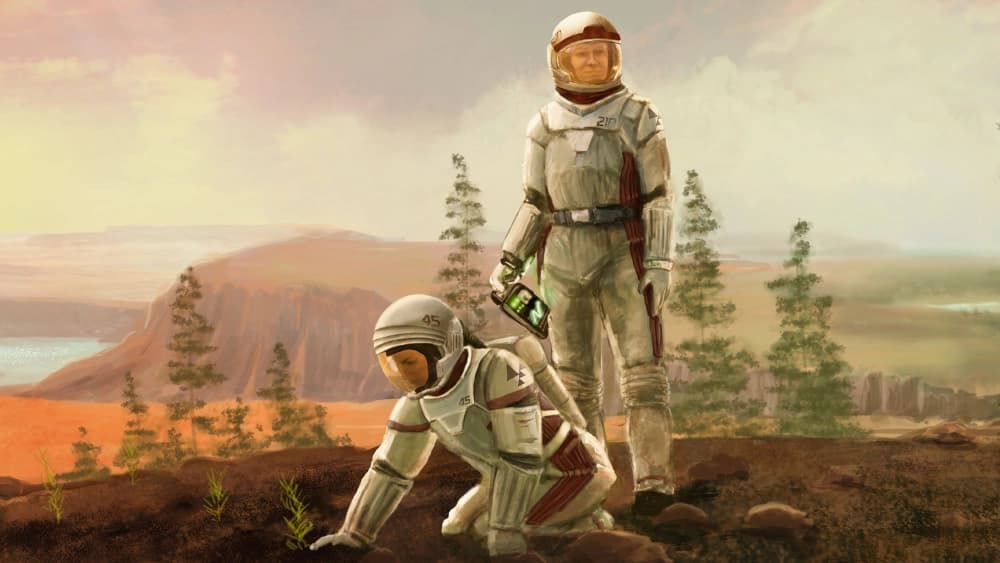
Terraforming means changing a planet so humans—and maybe other Earth life—could live there. For Mars, this would mean making the air thicker, raising the temperature, adding liquid water, and slowly creating oxygen. For years, people treated this like science fiction. Now, some researchers say it is no longer “impossible”—just very difficult—and worth studying carefully.
A new workshop summary led by Dr. Erika DeBenedictis argues that recent progress makes a research program sensible. Why the new interest? Launch costs may fall with new rockets. Synthetic biology and climate modeling are improving. Together, these tools suggest we can test ideas step by step, without trying to change a whole planet tomorrow.
One plan imagines three broad phases. First comes warming. Scientists could release special aerosols or greenhouse gases to raise Mars’s average temperature by a few tens of degrees. If the planet warms by about 30°C, ice below the surface could melt. Some studies say there is enough water to form a huge ocean—almost four million square kilometers, with depths near 300 meters. Is that exact outcome guaranteed? No. But it gives a clear target for testing.
The second phase is seeding microbial life. Engineers could design hardy microbes—extremophiles—that handle cold, radiation, and low pressure. These organisms might spread like thin, green growth and begin slow oxygen production. Would this take time? Yes—most likely decades just to start, and much longer to change the air in a big way.
The third phase looks far into the future. People could begin inside huge domed habitats, maybe 100 meters tall. Inside, plants and devices like water electrolysis machines could make oxygen. Outside the domes, plant life could slowly add more oxygen to the atmosphere. This last step would take centuries or even a thousand years. It is not a quick project.
Big questions remain. What exactly lies under the thick ice sheets? How would Mars’s famous dust storms behave in a warmer, wetter climate? Are the materials needed for large-scale water splitting available on Mars, or would we need many costly shipments from Earth? These unknowns show why careful research is needed.
There are also ethical issues. If we change Mars, we might lose a “pristine record” of its natural history. If tiny native life exists there, our actions could harm it. On the other hand, work on Mars could help Earth today. For example, tougher crops and closed-loop life-support systems developed for Mars might improve sustainability at home.
So, should we start terraforming now? The workshop says no. It recommends lab studies, detailed models, and small, local experiments on future missions to test warming methods. The key shift is this: the discussion is moving from “Could we?” to “Should we—and how could we study this safely?” Careful, step-by-step research may be the smart path forward.