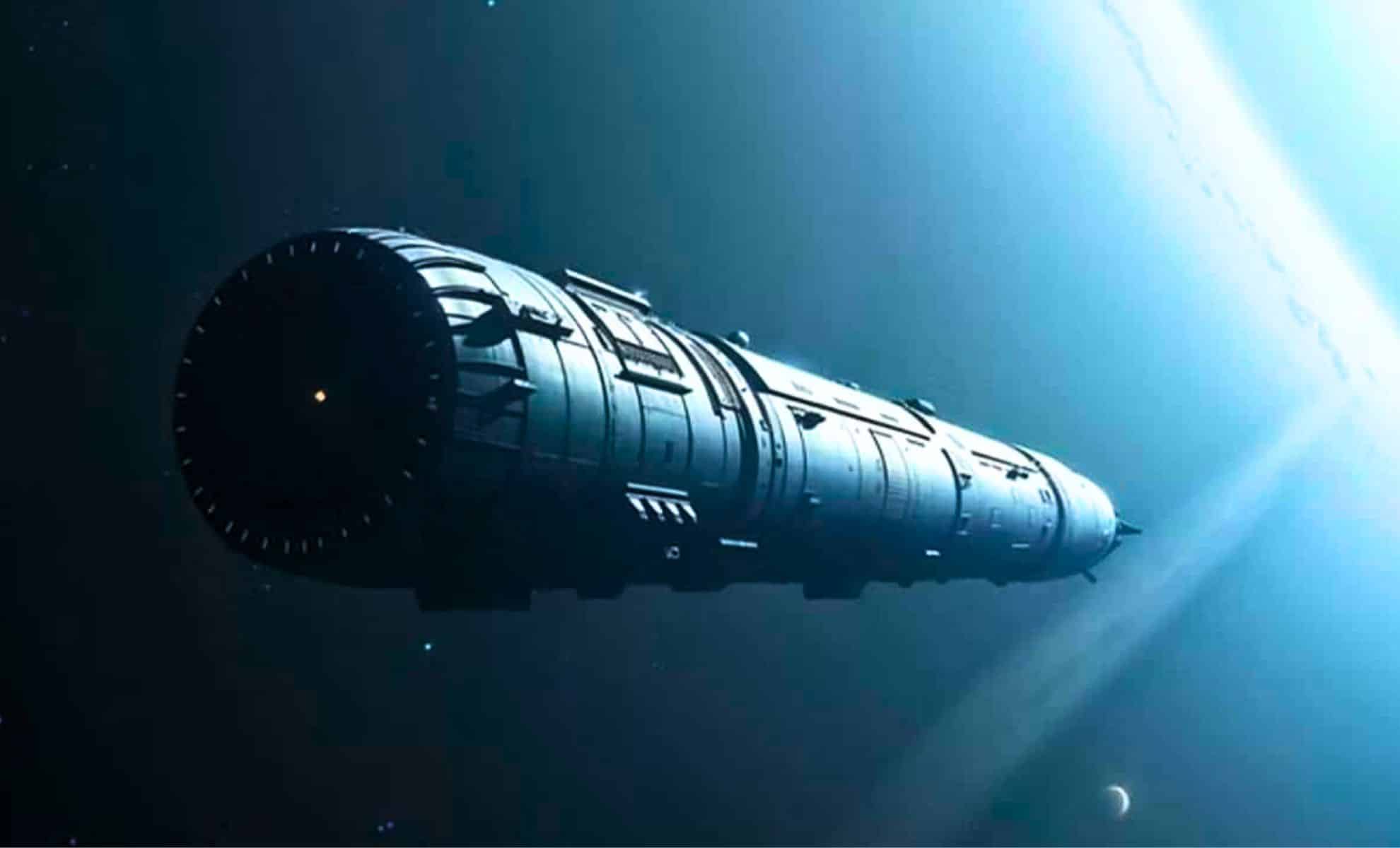
What if space travel stopped pretending to be a quick trip to Mars and became something stranger—a one-way move? That’s the idea behind Chrysalis, a generation ship concept designed to carry about 1,000 people into deep space, with no return ticket and no rescue plan. Comforting? Hardly. Honest about the distances involved? Maybe.
The ship would be enormous—dozens of miles long—because size solves a classic problem: gravity. Instead of leaving people to float and get sick, Chrysalis would rotate to create artificial gravity. Smaller craft must spin so fast that the human body protests. A giant vessel can rotate slowly, producing a gentler, more livable “down.” That’s the theory, and it’s the bare minimum for a centuries-long trip.
Destination: Proxima Centauri b, a possible planet around the nearest star to our Sun, about 4.2 light-years away. Travel time? Roughly 400 years. In other words, the people who launch the mission would never meet the people who arrive. Everyone in between would be born, live, and die on board. Still sound like a “journey,” or does it start to feel like a moving country?
To work at all, the ship must be more than a rocket. It needs the functions of a city: food systems, waste recycling, water treatment, schools, healthcare, and some form of politics that doesn’t collapse halfway through the 23rd century. Designers imagine rotating habitats, biome domes that mimic Earth’s environments, and a large central space—part assembly hall, part planetarium—so people can gather and remember why they’re out there in the first place.
Energy would likely come from fusion, backed by careful resource management. Artificial intelligence would help steer the ship, maintain life-support, and support education and governance. Yes, the robots would have a say; perhaps you find that reassuring, or perhaps your skin just crawled a little. Either reaction seems appropriate when you picture software helping to run a flying civilization.
Where would we build such a thing? Not on Earth. The idea is to manufacture it in space, at the Earth-Moon L1 point—a relatively stable spot where it’s cheaper to “park” and assemble large structures. Before launch, crews would train in harsh isolation, perhaps in Antarctica, to simulate the social stress of living in a sealed habitat for years. If cabin fever appears after six months, what happens after six generations?
Of course, this isn’t appearing out of thin air. The concept comes from a design competition connected with interstellar studies, where engineers and social scientists are trying to turn science-fiction “worldships” into something less magical and more mechanical. The goal isn’t to prove we can build it tomorrow, but to see which parts are physically possible and which parts—like keeping people sane and fair—are the real blockers.
So, should humanity build Chrysalis? On one hand, it’s the most realistic way to reach another star without fantasy drives. On the other, it demands a blunt acceptance: those who leave will never come back, and the future will be chosen by their descendants, not us. Courage or hubris? Survival plan or beautiful trap? The question refuses to sit still—much like the ship itself.