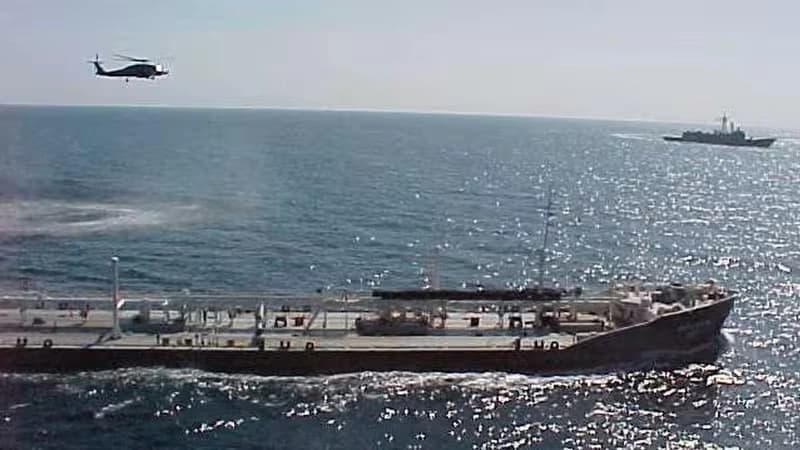
So let's get this straight: the United States just seized a ship carrying Venezuelan oil to China in international waters, and now everyone's scrambling to claim they're morally right. China calls it a "serious violation of international law." Venezuela screams "piracy." The White House insists it's completely legal because... sanctions.
But here's the question nobody seems to want to answer: whose international law are we talking about, exactly?
The Convenient Definition of Legality
The U.S. Coast Guard intercepted the tanker Centuries—conveniently registered in Panama, because of course it was—carrying about 1.8 million barrels of Venezuelan crude oil. The White House's justification? The vessel was "falsely flagged" and carrying "sanctioned oil."
Falsely flagged. Let's pause on that. In an industry where shell companies, intermediaries, and flag-of-convenience registrations are standard operating procedure, suddenly this ship's paperwork is the problem? The crude was purchased by Satau Tijana Oil Trading, yet another middleman in the maze-like world of PDVSA sales to Chinese refiners. If we're going after every tanker with creative accounting, we're going to need a much bigger Coast Guard.
International Law: Pick Your Version
China insists Venezuela has every right to engage in normal economic relations with other countries. Fair point—except "normal" went out the window the moment U.S. sanctions entered the picture. Venezuela, predictably, calls the seizure an act of international piracy. Also fair—depending on which lawyer you ask and which version of international maritime law they're reading that day.
The real question: when does enforcement of unilateral sanctions become extraterritorial overreach? The U.S. didn't ask for international consensus before imposing these sanctions. It simply declared them, then started intercepting ships in international waters when countries like China decided those sanctions don't apply to them.
The Shadow Fleet That Everyone Knows About
Let's talk about this "shadow fleet" that the White House loves to mention. It's hardly shadowy when everyone—including U.S. intelligence, Chinese customs, and apparently Reuters—knows exactly what's happening. Venezuela ships crude through intermediaries to China, which buys it despite American disapproval because, newsflash, China makes its own foreign policy decisions.
Venezuelan oil constitutes roughly 4% of China's imports. Not exactly a game-changer for Beijing, but principle matters. If China acquiesces to U.S. sanctions enforcement in international waters today, what's next? Inspections of Chinese-flagged vessels? Sanctions on Chinese refiners who dare to buy non-American-approved oil?
Piracy or Policing?
Here's where it gets philosophically murky. Is intercepting ships in international waters an act of law enforcement or an act of piracy? The answer depends entirely on whether you recognize the authority doing the intercepting.
The U.S. sees itself as enforcing legitimate sanctions against a regime it considers illegitimate. Venezuela sees a global superpower strangling its economy and now literally stealing its exports. China sees American hegemony trying to control who can trade with whom, anywhere on the planet.
They're all right. They're all wrong. It depends on your starting assumptions about who gets to make the rules.
The Real Winner? Uncertainty
What's undeniable is that this incident further muddies already turbulent waters—both literally and diplomatically. Venezuelan crude will still find its way to Chinese refiners; the routes will just become more convoluted, the intermediaries more creative, the insurance more expensive.
Meanwhile, the concept of "international law" takes another blow. If the world's major powers can't even agree on whether seizing a ship in international waters is legal, what hope do we have for consensus on anything more complex?
So who's the pirate here? Depends who you ask. And that, perhaps, is the most cynical answer of all.