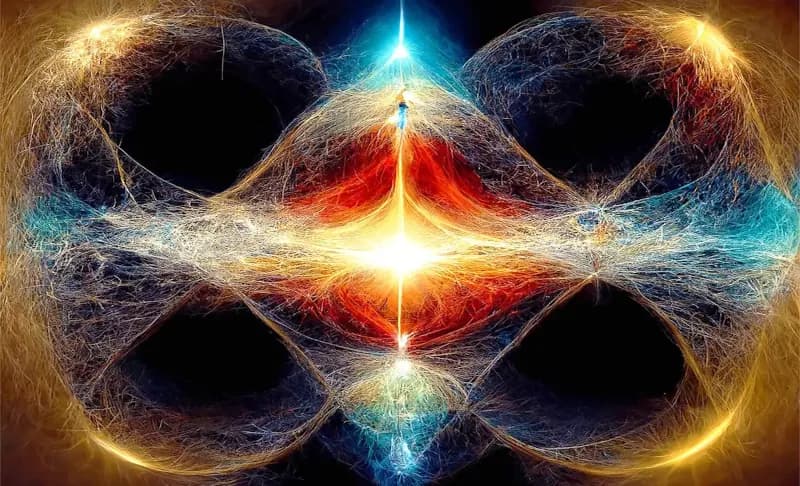
Could your desk, your coffee mug, or even the atoms in your phone be conscious—at least a little? That’s the question panpsychism raises, a theory suggesting that consciousness might be a fundamental feature of the universe, as basic as matter or energy. Although this idea has ancient roots, it’s gaining attention again among modern scientists and philosophers.
Instead of viewing consciousness as something that only arises in complex brains, panpsychism proposes that even the tiniest particles may possess a kind of proto-experience. This doesn’t mean your smartphone is meditating, but that the building blocks of the universe might hold the seeds of awareness.
From ancient Greeks like Thales and Anaxagoras to Renaissance thinkers like Giordano Bruno, many have flirted with this idea. In the Enlightenment, Leibniz imagined “monads”—tiny, soul-like units mirroring the cosmos. Modern proponents, like neuroscientist Giulio Tononi, have developed theories such as Integrated Information Theory (IIT), which quantifies consciousness through a measure called Φ (phi). The higher the integration of information in a system, the richer its conscious experience might be.
Quantum theories, such as Orch-OR by Roger Penrose and Stuart Hameroff, push the envelope even further by suggesting consciousness arises from quantum activity within brain cells. While many scientists are skeptical—arguing our brains are too warm and chaotic for such quantum coherence—the possibility still intrigues researchers.
The key challenge? Explaining how tiny bits of awareness could combine into the vivid human experience we all know. This “combination problem” is panpsychism’s biggest hurdle. Yet, by embedding consciousness into the very fabric of reality, panpsychism offers an escape from the age-old puzzle of how matter creates mind.
Whether this theory turns out to be revolutionary science or philosophical fancy, one thing is clear: the debate is far from over, and the quest to understand consciousness might reshape how we see everything—from rocks to robots.